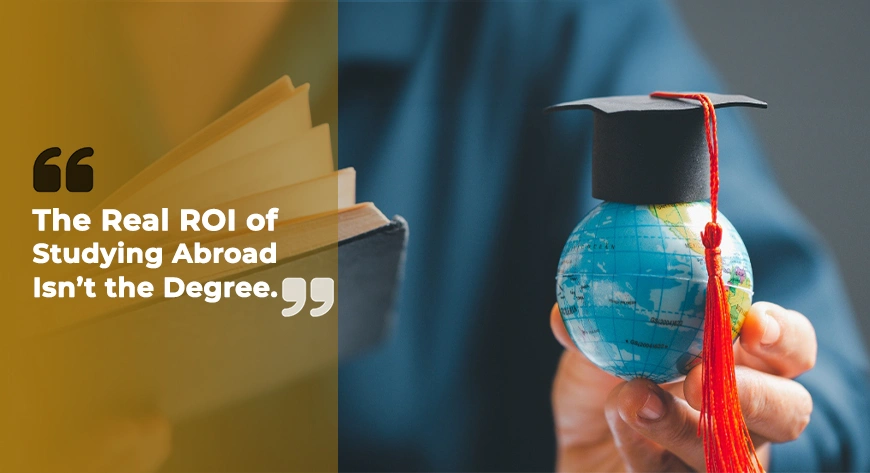
What Are You Really Paying For When You Study Abroad?
When people talk about the return on investment of studying abroad, they usually start with one thing:
The degree.
But a degree is only one part of what you’re investing in.
You’re also investing in your time, your living expenses, your experience, your network, and the years you spend building your professional future.
So the real question isn’t:
“Will I get a degree?”
You already know the answer.
The better question is:
“What will I have at the end of this journey that I didn’t have before?”
That’s where the real ROI starts.
1. Knowledge Is Only the Starting Point
A degree gives you academic knowledge and a qualification in your field.
But studying abroad can also put you in an environment where you’re exposed to different approaches, academic perspectives, and ways of solving problems.
The value isn’t simply in collecting information.
It’s in learning how to use it.
The more you connect what you learn in the classroom to real situations, projects, discussions, and challenges, the more valuable that education becomes.
The degree proves what you studied. Your capabilities show what you learned from it.
2. Your Network Can Become One of Your Biggest Returns
One of the most underestimated returns of international education is who you meet along the way.
Classmates can become colleagues.
Professors can become mentors.
University connections can lead to internships, collaborations, opportunities, or simply introduce you to people and industries you wouldn’t have encountered otherwise.
And an international network can extend far beyond the country where you studied.
But networking isn’t about collecting LinkedIn connections.
It’s about building real professional relationships.
The people you meet during your studies can become part of your professional ecosystem long after graduation.
3. You’re Building Experience, Not Just Earning Credits
Your university experience can extend far beyond lectures and exams.
Depending on your program and destination, you may have opportunities to participate in:
- Internships
- Projects
- Competitions
- Research
- Student organizations
- Industry events
- International collaborations
These experiences can help you graduate with something more valuable than a transcript:
evidence of what you can actually do.
And when you eventually apply for a job, that distinction matters.
4. Independence Has Professional Value
Moving to another country forces you to handle things you may have never had to manage before.
Budgeting.
Time management.
Communication.
Problem-solving.
Making decisions without having someone immediately solve the problem for you.
These may sound like personal skills—and they are.
But they’re also professional skills.
Employers don’t only hire people based on what they know.
They also need people who can adapt, communicate, take responsibility, and figure things out.
Living independently can accelerate the development of exactly those abilities.
5. International Exposure Can Change How You Think
This is one of the hardest returns to measure—and one of the most valuable.
Studying alongside people from different countries and backgrounds can challenge assumptions you didn’t even realize you had.
You may encounter different:
- Perspectives
- Work styles
- Communication styles
- Business approaches
- Cultural expectations
- Ways of solving problems
That exposure can make you more comfortable working with people who don’t think the way you do.
And in an increasingly international workplace, that matters.
Global exposure isn’t just about seeing more of the world. It’s about learning how to operate in it.
6. Your Career Options Can Expand
The biggest return may ultimately be what your international education enables you to do next.
A strong educational experience can help you build:
Knowledge → Skills → Experience → Network → Opportunities
And those opportunities can take different forms:
- Further education
- Internships
- International careers
- Cross-border opportunities
- Professional collaborations
- New career directions
Studying abroad doesn’t guarantee any of these outcomes.
But the right environment can give you access to opportunities that may not have been available to you before.
Access is part of ROI. What you do with that access is what turns it into value.
So, What Is the Real ROI?
It’s not just the degree hanging on your wall.
It’s the combination of what you know, what you can do, who you know, how you think, and what opportunities you can access afterward.
That’s why comparing study-abroad options based only on tuition fees can be misleading.
You’re not simply paying for classes.
You’re investing in an ecosystem.
And like any investment, the return depends on the quality of what you choose—and how actively you use it.
Before You Choose, Ask Better Questions
Instead of asking only:
“How much does this degree cost?”
Ask:
- What skills will I graduate with?
- What practical experience can I gain?
- Who will I have access to?
- What kind of international exposure will I get?
- What opportunities could this experience open up?
- How does this program connect to where I want to go next?
These questions shift the decision from price to value.
And that’s a much better way to think about your investment in education.
The Degree Is the Certificate. The ROI Is Everything Around It.
Studying abroad is a significant investment.
So it deserves to be evaluated beyond the degree itself.
Look at the education.
Look at the experience.
Look at the network.
Look at the opportunities.
And most importantly, look at how all of them fit into the future you’re trying to build.
Because when you choose the right international education experience, you’re not only investing in what you’ll graduate with.
You’re investing in what you’ll be able to do next.
Explore Your International Education Options
CEO Entrepreneurs Institute helps students explore international education opportunities and find programs that align with their academic goals and future ambitions.
Start Your Journey with CEO Entrepreneurs Institute.
